Dynamic Range Specs Are Mostly Marketing — Here's What to Read Instead
Manufacturers quote stops of dynamic range the way speaker makers used to quote watts. The number is real, the measurement conditions usually are not stated, and the useful figure is a different one entirely.
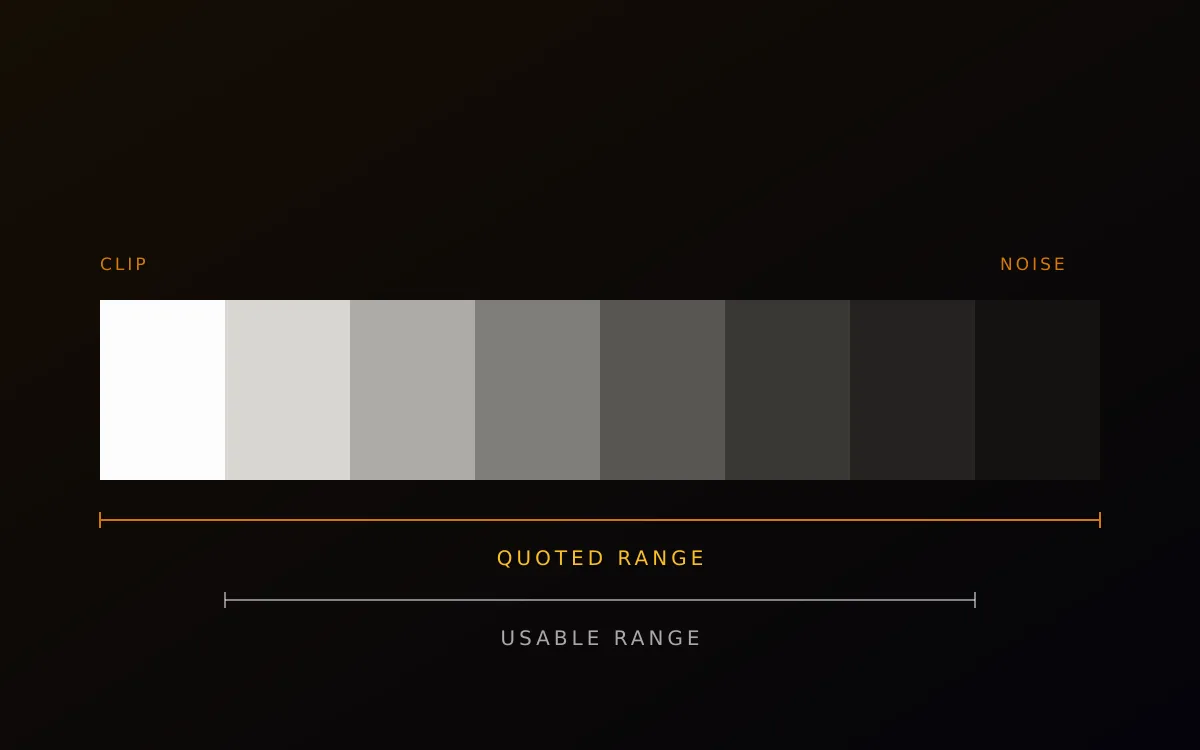
Every camera announcement quotes a dynamic range figure. Fifteen stops. Sixteen stops. The numbers climb every generation, and they are not fabricated — but they are close to useless for comparing cameras, because the conditions that produce them are almost never stated.
Here is what the number actually means and what to look at instead.
What a "stop" of dynamic range is measuring
Dynamic range is the ratio between the brightest signal a sensor can record before clipping and the darkest it can record before the signal disappears into noise.
The top end is well-defined: the photosite saturates, and above that there is no information. Nobody argues about clipping.
The bottom end is where the marketing lives. "Disappears into noise" is not a physical threshold — it is a judgement call about how much noise you are willing to tolerate. Change that threshold and the number changes by several stops, using the exact same sensor and the exact same measurement.
The two definitions, and why they differ by three stops
Engineering dynamic range counts down to where the signal-to-noise ratio hits 1:1 — where signal and noise are equal. At that point there is technically information present. It is not information you would put on screen; a shot graded up from there is a wash of colour noise.
Usable dynamic range counts down to a threshold where the image is still acceptable — commonly an SNR of 2:1 or higher, sometimes with a specified noise measurement.
The gap between these two definitions is routinely two to three stops. A manufacturer quoting engineering dynamic range and a reviewer measuring usable dynamic range will report different numbers for the same camera and both will be reporting honestly.
When a spec sheet does not say which definition it used, assume the more flattering one.
The variables that are almost never disclosed
Even within one definition, the figure moves depending on conditions that rarely appear in marketing:
- ISO. Dynamic range peaks at base ISO and falls off from there. A camera with two base ISOs has two different peaks. Quoting the best one is standard practice.
- Downsampling. Measuring at full sensor resolution gives a lower number than measuring a downsampled image, because averaging neighbouring pixels averages away noise. Both are legitimate; they are not comparable.
- Codec and bit depth. A sensor capable of fifteen stops recorded to a heavily compressed 8-bit file does not deliver fifteen stops of gradeable range.
- Noise reduction. In-camera processing that runs before the measurement inflates the result substantially.
Four undisclosed variables, each worth a stop or more. This is why two credible sources can differ by three stops on the same body without either being wrong.
What to read instead
Where the noise sits, not how much there is. Total noise matters less than its distribution. Fine, even luminance noise grades well and reads as texture. Chroma blotching and horizontal banding do not, and no amount of noise reduction fully removes them. A camera with slightly more noise that is well-behaved beats one with less noise that falls apart in the shadows.
Highlight rolloff. How the sensor approaches clipping matters enormously for anything with skies or practical lights in frame. A gradual rolloff is usable; a hard clip is not, and the dynamic range figure does not distinguish them.
Colour under recovery. Push the shadows three stops and see what happens to skin tones. Some sensors hold colour; others shift toward magenta or green in a way that is tedious to correct across a whole timeline.
Dual-gain behaviour. If a camera has a second base ISO, the interesting question is what happens between the two — whether there is a range where you are getting the worst of both.
How to actually compare two cameras
Ignore the spec sheets and find footage that stresses the specific thing you shoot.
If you light interiors with windows in frame, look for that shot. If you shoot concerts, look for hard-lit faces against black. Then grade it — download the original file rather than watching a compressed review video, lift the shadows the amount you would actually lift them, and see which one you would rather deliver.
That takes an afternoon and tells you more than every dynamic range figure published this year.
The short version
The spec is not lying, it is underspecified. Treat a quoted dynamic range figure the way you would treat a quoted top speed: technically achieved, under conditions unlike yours. The differences that matter between modern cameras are in noise character, highlight rolloff and colour under grading, and none of those compress into a single number.